- Purpose: To help partners understand their dynamic, improve communication, and find a path forward, whether that means staying together or separating amicably.
- Focus Areas: Resolving communication breakdowns, rebuilding trust, managing life transitions, and breaking toxic argument cycles.
- Process: Therapy typically involves joint sessions to explore relationship patterns, though individual sessions may also be recommended to support the process.
- Benefits: Couples gain the tools to express vulnerability, safely resolve ongoing conflicts, and cultivate a deeper, healthier emotional connection.
What is Relationship and Marriage Counselling?
Relationship and marriage counselling, officially known as Marriage and Family Therapy (MFT), is a therapeutic process where a licensed professional helps partners identify, understand, and resolve conflicts to improve their relationship. This form of psychotherapy addresses the specific behaviours of each person and how these actions impact the relationship dynamic as a whole. Rather than simply having a professional “fix” your problems, the counsellor guides you through a complex self-exploration process.
Couples learn to become honest and vulnerable, gaining the curiosity needed to genuinely understand each other’s needs. Engaging in marriage and couples counselling before major problems occur is also highly recommended by experts. It serves as a preventative measure to boost communication and stop small misunderstandings from turning into significant roadblocks.
Signs You Need Therapy for Relationship Issues
The clearest signs you need therapy for relationship issues include chronic communication breakdowns, constant arguing, and a loss of trust or emotional connection. When heated disputes or silent withdrawals become your normal routine, professional intervention is necessary to break the cycle. Over time, these patterns create distance and tension, allowing other issues to grow beneath the surface.
My colleague at Counselling in Melbourne, Holly Jade, perfectly describes what this communication breakdown often looks like in our clinic. She explains: “We often see couples where one partner is trying to raise a concern, perhaps saying, ‘I feel like we don’t spend enough quality time together,’ and the other hears this as criticism, responding defensively with something like, ‘Nothing I do is ever enough for you.’” Holly notes that this quickly shifts the conversation into blame or shutdown, leaving both people feeling unheard and misunderstood.
Here are the primary signs it is time to seek professional help:
- Communication breakdown: You feel like you are speaking different languages, or one partner withdraws into silence while the other feels ignored.
- Constant arguments: Routine disagreements frequently escalate into contempt, defensiveness, or stonewalling.
- Loss of trust: A betrayal has occurred, and you need a safe environment to navigate giving each other a second chance.
- Repetitive toxic patterns: The same problems surface every time a complaint is raised, keeping you stuck in an exhausting loop.
- Emotional disconnection: You feel lost, lonely, or entirely disconnected from your partner without fully understanding why.

Couples Counselling: What to Expect in Your Sessions
You can expect your couples counselling sessions to provide a secure, neutral environment focused on slowing down conflict and building psychological safety. It is completely normal to feel nervous before your first appointment, especially if this is the first time you have spoken openly about your relationship to a third party.
What Happens in the First Session?
Your first session focuses on understanding your relationship history, exploring your dynamic, and establishing a safe space rather than diving straight into intense problems. Holly Jade shares her clinical approach: “Rather than diving straight into problems, the first session is often about slowing things down and creating a sense of safety. As a starting point, you may be invited to reflect on a simple but meaningful question: ‘What made you choose this relationship and what has made you stay?’” By exploring these layers gently and without judgement, the counsellor helps shift the focus from conflict back to connection. At times, the session may slow down to bring awareness to your present-moment experience, supporting a shift out of reactivity and into greater understanding.
Will the Counsellor Take Sides?
No, a professional relationship counsellor will never take sides. Their role is to remain impartial and understand both partners’ perspectives to help you collaboratively resolve the problem. While it can sometimes feel frustrating when the therapist doesn’t declare one person “right,” this strict neutrality is essential for healthy mediation.
Do We Need to Prepare Anything?
You do not need to prepare anything formal; it is most important that you simply come as you are. However, it can be helpful to think about the primary concern you want to address and what a positive step forward would look like for you.
Types of Couples Therapy We Use
Relationship counsellors utilise several evidence-based therapies, including The Gottman Method, Emotionally Focused Couples Therapy, and Cognitive-Behavioural Therapy, to help couples overcome their specific challenges. Your therapist will tailor their approach based on your unique dynamic, past experiences, and shared goals.
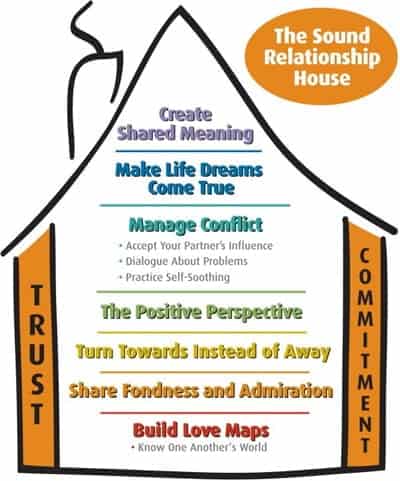
Source: gottman.com
The Gottman Method
The Gottman Method is a highly structured approach based on four decades of research into marital stability and divorce prediction. It focuses on identifying and managing the “Four Horsemen” of relationship breakdown: criticism, contempt, defensiveness, and stonewalling. By neutralising these destructive behaviours, couples can build a “Sound Relationship House.”
Emotionally Focused Couples Therapy (EFT)
Emotionally Focused Couples Therapy is a short-term approach that focuses heavily on attachment theory and emotional responses. It helps distressed couples understand their underlying emotional needs and creates safer, healthier interaction patterns.
Cognitive-Behavioural Therapy (CBT)
Cognitive-Behavioural Therapy helps partners identify how dysfunctional thinking patterns lead to negative emotions and problematic actions within the relationship. By actively challenging these negative attitudes, couples can find practical solutions and communicate much more effectively.
How to Find a Relationship Counsellor in Melbourne
To find a qualified relationship counsellor in Melbourne, you should verify their professional registration (such as with AHPRA or the APS) and ensure they have specific experience in couples therapy. Because the internet is filled with self-proclaimed relationship “experts,” it is vital to seek out licensed psychologists or counsellors with evidence-based training.
Once you find a clinic that aligns with your needs, do not hesitate to ask questions about their specific therapeutic approach and experience level. If you are ready to take the next step towards a healthier dynamic, you can book an appointment with our experienced team at Counselling in Melbourne today.
Please note that the information provided in this article is for educational purposes only and should not substitute professional medical or mental health advice. If you or someone you know is in immediate distress or needs assistance, please reach out to a mental health professional or helpline in your country or state.
ABOUT THE AUTHOR
Amelia Cambrell
My name is Amelia, and I’m a Senior Psychologist at Counselling in Melbourne. I have over 18-years of experience in the mental health space. I am very driven to get the best outcomes for my clients, which can be long-lasting by using a range of modalities such as CBT. There is nothing more satisfying than helping adolescents, adults and couples who are feeling confused, frustrated, stuck or overwhelmed, to find more clarity, confidence and happiness in their lives.
Please note that the information provided in this article is for educational purposes only and should not substitute professional medical or mental health advice. If you or someone you know is in immediate distress or needs assistance, please reach out to a mental health professional or helpline in your country or state.